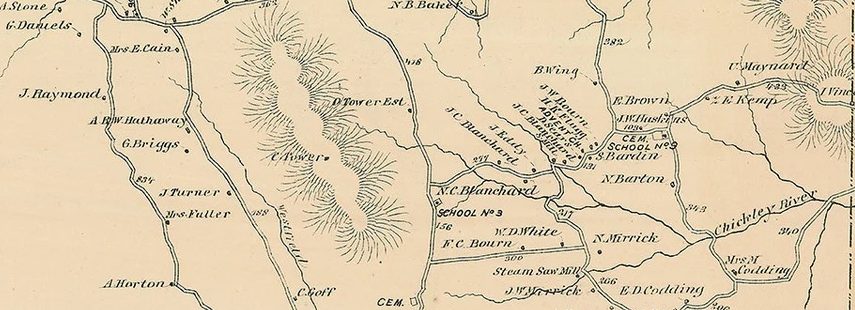

As I have been learning about Herbert Blanchard, his family, and his world, I have found myself in a constant struggle against the rabbit hole. The battle starts in places of his life story that are a blank to me, or where I simply want to place him in his era.
The struggle is to know when to stop. It seems easy at first, but when you’ve been in the rabbit hole and found treasures, it’s challenging to just climb out. Especially those rabbit holes that start out seeming full of trivia, when you suddenly stumble on essential information about the subject at hand. Such has been the case for certain parts of Blanchard’s story, when he ran away from home not much more than a boy, and found himself in a Nebraska territory at war with the Sioux. Digging up trivia about daily life on the frontier helped uncover some details about his personal journey.
Such has not been the case with my research into the Civil War, which provided a bloody background to Herbert’s daydreams of violence, and eventually took many of the men who served as role models during his childhood in West Hawley. It’s been all rabbit hole.
Still, though. Herbert’s father, Daniel Blanchard, went away to the war, and came back only to raise another family, having divorced Herbert’s mother while Herbert was still a toddler. Growing up in a West Hawley farmhouse with his grandparents and and aunts and uncles, Herbert saw the home of Chandler and Minerva Blanchard become emptier as the war progressed.
So, to understand what that might have been like, I dove into the civil war records of not only Daniel Blanchard, but of his several siblings and siblings-by-marriage who volunteered to preserve the union. These included Herbert’s uncle Chandler Henry Blanchard, who lost a leg fighting in the Shenandoah Valley, and Chandler’s 16-year-old brother Everett, who leapt to his death from the third floor of the military hospital in Annapolis, his sanity eroded by typhoid fever contracted in the service.
And then there’s the sad story of Edwin Meacham, a Worthington farmer who enlisted with his brothers William, Joel, and James at the start of the war, and the subject of my rabbit hole dive because, during a furlough granted following his decision to sign up for another tour of duty, Edwin Meacham married Herbert’s aunt Permelia Blanchard (his brother William had married Permelia’s sister Rhobe just before the war).
Permelia would never seen Edwin again, however: in Mid-May 1864, he was captured by the Confederates at the Battle of Drewry’s Bluff, and would spend the summer in the concentration camp that the pro-slavers called Camp Sumter, but which is more commonly known as Andersonville Prison.
In the autumn, as the forces under General William Tecumseh Sherman laid waste to Atlanta and beyond, Meacham was among those deemed well enough to be transported Camp Lawton (Millen, Georgia), from which prisoners were reportedly to be transported by rail to the port of Savannah, as part of a release deal with the Union. Edwin never made it. He succumbed to scurvy and dysentery in late October.
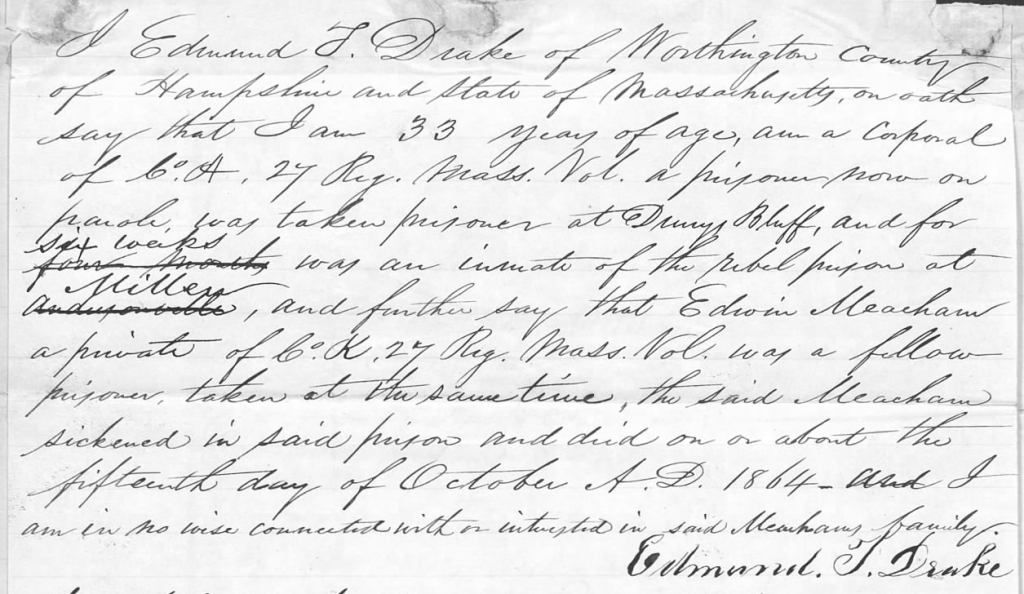
It’s particularly sad to me to read these stories of soldiers who had largely uneventful first tours, only to re-up and be maimed or killed. The same happened to Meacham’s brother James, taking a bullet to the head at Cold Harbor, two weeks after Drewry’s Bluff.
In the normal process of research, I kept noticing accounts of an *Edward* Meacham with a similar life story, with some small details of difference, such as the regiment he fought for, and the woman he married, but ending the same in a confederate prison. Accounts and references such as Find a Grave and Fold3 would refer to Edwin/Edward serving in two consecutive regiments. Which wouldn’t be unheard of, I guess.
I would remind myself, this is a tiny part of the story I’m telling, a footnote, really. But it’s the kind of detail that will stick in my craw, and leave me doubting my research. I can get a little nutty about it.
So …

The Massachusetts Soldiers, Sailors, and Marines in the Civil War does indeed list the soldier I described as Edwin Meacham of the 27th, and there’s an Edward Meacham in the 34th. But the Army’s own records aren’t this consistent about the names. Indeed, I can’t find anything outside the inconsistent Army returns — other than accounts directly lifting from them– that even calls *either* of these men Edward.
So there was nothing to do but construct a timeline from these records and see what made sense. What emerges is a perfect storm of *just close enough* to result in the double life of Edwin “Edward” P. Meacham.
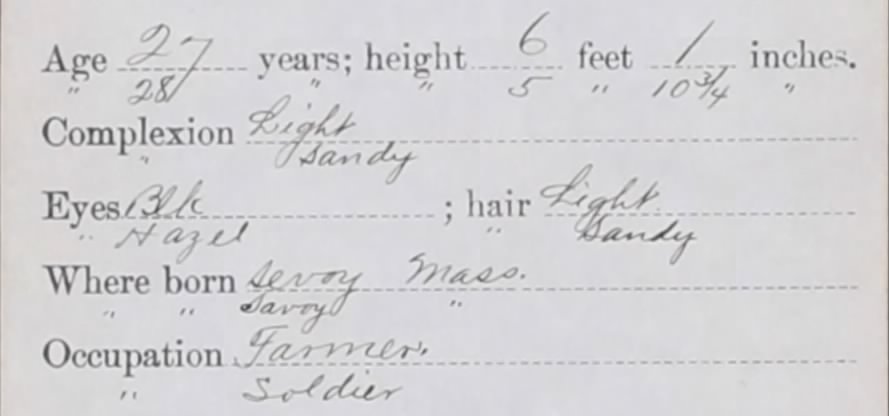
Edwin Meacham the son of Haliburt and Caroline Meacham of Worthington, married Sara Clapp the same fall Edwin Meacham, the son of Reuben and Orpha Meacham of Savoy, was signing up for service with his brothers. The Worthington Meacham, described as being several inches shorter than the other Edwin, enlisted the following summer, assigned to Company B, “Captain Potter’s Company,” of the 34th. He was promoted to corporal on March 8, 1864, and wounded in the leg at New Market the following week. His promotion happening after Savoy’s Edwin’s return from furlough makes the regiment change of a lone Edwin plausible. The problem is the actual muster rolls make that impossible, later.
The same summer that Edwin Meacham of the 27th was suffering the horrors of Andersonville, Edwin Meacham of the 34th was recuperating in the Army hospital in Annapolis. Again, both were absent from the muster rolls about the same time. Around the same time that Edwin Meacham “27” was dying in Georgia (and at the same battle that destroyed Chandler Blanchard’s leg), Edwin Meacham “34” was taken prisoner, and held at a location I’ve yet to determine. He was paroled in January 1865, returned to Annapolis, mustered out in June, and returned home to western Massachusetts.
In the Army records, Edwin and Edward are interchanged to a confusing degree, perpetuating the error in secondary accounts. So much so that doubt continued to nag me, even with the impossible timeline right in front of me. But then I stumbled upon a newspaper clipping that finally sealed the entire deal, eliciting an obscenity-laded exultation from yours truly. An 1868 obituary column in the Greenfield Recorder finally put it all to rest, giving me a death date and a regiment:

Edwin Meacham of the 34th died of consumption on July 25, 1868, at the home of E. B. Tinker of Huntington. I can find no record of where this Meacham is buried. Edwin of the 27th has two graves, at Beaufort National Cemetery, where his remains were likely interred, and at Hawley’s West Hill Cemetery, more likely a memorial cenotaph.
Finding Edwin Meacham of the 34th in his deathbed a mere three years after the war’s end finally explained why the two men got confused in such a complete manner. Both imprisoned around the same time, dying during or soon after the war, childless, and with Edwin’s final resting place unclear, who would not conclude they might be the same person?
Other than a madman in a rabbit hole.
 The Many Wives of Herbert Blanchard
Leave a comment