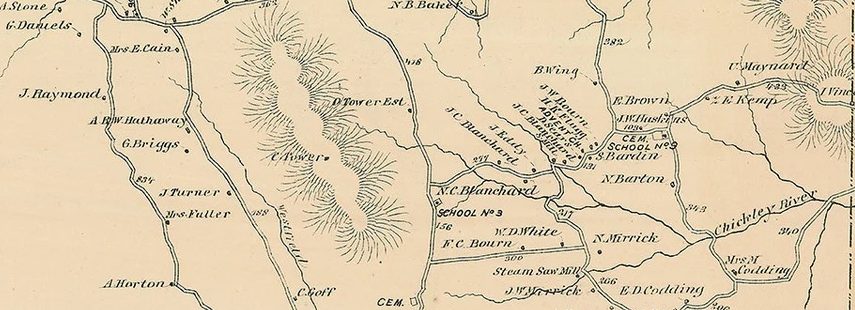
In the late 1920s, Wilbur Julius Starks (1862-1944), the custodian of the Deer Hill Reservation in Cummington, Mass., penned or dictated a series of columns for the Springfield Daily Republican, sharing old stories about Deer Hill and its environs, largely anecdotes passed down from his father’s generation of the Starks family of Savoy, some of the earliest settlers who farmed the unforgiving hills since its earliest days as “New Seekonk.”
In a 1927 piece, Starks wrote about discovering an ancient “double arch” (a stone hearth with two fireboxes) in the Cummington reservation, jogging memories of the 19th-century New England technique for boiling down sap using large iron kettles. He recognized the structure because his father, Albert Starks (1831-1913) “had all the implements and the knowledge of how to use them that his grandfather had.”
This knowledge and the implements were brought from Rehoboth when my great-grandfather went to Savoy and built a log house and later cleared the land and made it into a farm where my father and grandfather were born, lived, and now lie buried. My father had kept these old implements for making maple sugar and had built one of these double arches in the woods near our house, and sometimes in a sugar season he would show us boys how they made sugar in the good old days.
Wilbur remembered his father as quite handy cultivating nourishment as a farmer, hunter, beekeeper, and adept in the boiling of the sap.
The Deer Hill stories, set before 1855, discuss encounters with bears while harvesting butternuts and, yes, ginseng in the woods, and there’s even a heartwarming romance of a Deer Hill orphan finding love.
But it’s the tale of two foxes that I want to share in detail.
For the January 20, 1929, installment of “Deer Hill Stories,” Wilbur Starks again brought readers back to the Cummington of the first half of the 19th century and the forests of spruce, hemlock, oak, and maple of the Deer Hill reservation, bursting with butternuts and prowled by the region’s hunters, including his father, Albert Starks, for game.
The story, passed down by Albert, told of one day’s fox hunt by boys of Savoy from the Blanchard and Starks families: Brier-born brothers Joseph Chandler Blanchard (b. 1817), Levi Blanchard (b. 1827), and William Jason Blanchard (b. 1830). All were excellent hunting lads, but Jason, as he was called, held distinction: he lusted for the sport and relished the flavor of game meat. From the southern part of Savoy, of Prince and Abigail Starks’ eight children, Maurice (b. 1813) and Albert (b. 1831) were the most handy at hunting, counting both game and bees among their quarry.
One winter’s day would lead to a chance meeting between the two clans and a third opponent out to bag a fox.
One day in winter, when conditions were just right, Chandler and Jason Blanchard decided to go hunting on Deer Hill. They got everything ready, and with their team of nice black horses, “Tunker sled,” dogs, etc., they started long before daylight for Deer Hill. They drove to a house where lived Frank Holdridge, this being the nearest house to Deer Hill, put the team in the barn, and started on foot for their day’s hunting on the hill. That same morning, very early, Maurice and Albert Starks started fox hunting on “Still Hill.” This was and is about seven miles in a straight line from Deer Hill.
As it so happened, a family by the name of Remington lived near Deer Hill, and a pair of Remington boys also enjoyed a shot at fox. Noting the fresh snow that morning was just right for tracking game, they raced through their chores, gathered their guns and their foxhounds, and made straight for Remington Hill, then a heavily-wooded tract of land situated on the south side of the north branch of the Westfield River, across the river from Deer Hill.
Soon after the Starks boys reached Still Hill, their dog started a fox and they soon saw that it was a “racer.” A “racer” was a fox that instead of running in circles a mile or two in circumference, after running a short distance, strikes off for another hill perhaps five miles or more away, and after making a few small circles there, strikes off again for another hill, and so on all day, perhaps reaching the place where it was started, just at night, or perhaps not at all that day.
The Starks boys could hear their dog making a break for Deer Hill. When it grew silent, they struck out and conducted the strenuous hike to Deer Hill, relieved to hear their dog again and thrilled to observe the fox still circling the slope of Deer Hill.
They got into position to shoot the fox as he came round on the circle, but just then heard two shots fired together in the direction from which their dog was coming. “Gosh,” said Maurice, “someone has shot the fox ahead of our dog!” Sure enough, in a few moments their dog stopped barking, and the boys started as fast as they could toward where they heard their dog barking last, and soon they saw him coming, carrying his tail low, as a good fox dog sometimes does when someone besides his master has shot the fox he was running.
It was then they spied one of the Remingtons coming around bearing a freshly-killed fox.
“What do you mean, shooting a fox ahead of our dog?” said Maurice.
“What are you hunting over here for anyway? Why don’t you stay in Savoy, where you belong?” said Remington.
“Huh, it’s a free country. We can hunt where we’re a mind to; besides, our dog followed that fox here, and we came after him,” said Albert Starks.
“Ya-as, and I got him, and what you goin’ to do about it?” said Remington.
“Take it away from you, by gosh. That’s what we’re going to do,” said Starks.
“No you won’t, and you’d better not try it,” said Remington.
But then the wilderness delivered what might have seemed a fair reward for the Starks boys. The group heard another dog approach fast on a fresh track. The Starks team bolted for the fresh fox circle, which turned out to have been the result of a Remington dog chasing a fox over the frozen river and up Deer Hill, the two foxes literally running rings around each other. The Starks boys lined up a shot, and firing almost at once, dropped the fox.
And the Remingtons almost dropped them.
Just before the Starks dog reached the fox, the Remington dog came along on the track, and seeing up to the dead fox , and seeing the Starks dog about to reach the fox he at once sprang over the fox ready to fight the Starks dog, which was a right and proper thing for him to do. Of course the Starks dog was bound to get the fox in place of the one that was taken from in front of him, and at once a lively dog fight was on. Albert Starks came up first and started to get the fox before parting the dogs. At once the Remington dog grabbed Starks by the right wrist and bit it quite badly. Then Starks’s dog got Remington’s dog by the throat.
“Take your dog off mine, or I’ll drop him,” a Remington shouted.
“You drop our dog and I’ll drop you,” said Maurice Starks.
And here’s where the story gets downright legendary, and cinematic.
It seemed certain that there was to be a tragedy right there as all were excited and in deadly earnest. But at that moment another dog was heard barking loudly as though on a fresh scent and fast coming toward them. All forgot their differences for the moment and stood wondering what was coming now. Every man stood with his gun at his shoulder, all forgetting the unwritten hunters’ law that no man should shoot game ahead of another man’s dog. Even the dogs had forgotten their urge to fight each other and stood listening to the swift and sure approach of that other dog …
Suddenly there bounded into view, not a fox, but a large buck, antlers laid back, tongue hanging out, eyes wild with fear and despair, a sight to cause pity in the minds of many, but these men felt nothing but amazement, as none of them had seen deer hunted with dogs before.
And just as the the buck passed from their sight, two shots rang out, followed by a shout: “Chan! Chan! I’ve got him! Come on! Come on!”
Then all came to life, dogs and men, and rushed over to see what had been done, and soon saw Jason Blanchard standing over the still-kicking buck and in his hand the knife with which he had just cut its throat; and Jason’s brother Chandler was coming as fast as he could.
“Good boy, Jase. Good boy,” Chandler, as he was called, addressed his brother.
The Remingtons did not find it good at all, not one bit.
“Hey there,” said one of the Remingtons, “I call it kinder low down to hunt deer with a dog.”
Albert Starks chimed in, not seeming so much offended as opportunistic: “You bet ’tis, and now we’ve seen ye do it, you’ll divvy up with us, won’t ye?”
“Divvy up nothing,” said Chan Blanchard. “What do you think? If my dog starts a deer, do you think I’m goin’ to let him run himself to death and I not stop the deer? I guess not. Whatever my dog starts I get, if I can.”
But what was left of the conflict burned out with the setting sun and the prospect of the long journey back to Savoy.
They all took hold and helped the Blanchards get the buck to where they could get it with their team. Jason was left to watch it, and Chandler went for the team, and the rest started for home.
We owe it to Wilbur Starks for preserving these pieces of folklore from the hills, for giving us a glimpse into the lives of these 19th-century youths scraping subsistence and sport from the wilderness.
I am especially thankful for the story, however, as it gives a peek into the younger days of two significant players in the life of Herbert M. Blanchard, desperado. In 1855, with probably still more bucks on his kill log, the Reverend William Jason Blanchard, a preacher of the Seventh-Day Adventist faith, would become the father of Jane Lois “Jennie” Blanchard, fated to marry Herbert Blanchard of Hawley.
The miserable conclusion of that marriage, which had occurred over the strenuous objections of the gun-toting and knife-wielding pastor, would result in a blood feud pitting Blanchard against Blanchard, and would ultimately leave that same Albert Starks sprawled and bleeding at the steps of the Adventist chapel in Savoy, laid low by a bullet from Herbert Blanchard’s revolver.

 The Many Wives of Herbert Blanchard
Leave a comment