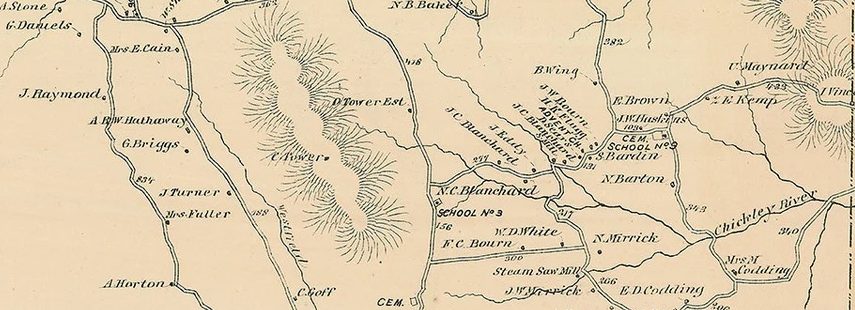
Benson Munyan, the man who would lead Herbert M. Blanchard to his ultimate date with justice, was born in the village of Leeds in Northampton, Massachusetts in 1837, the son of a Methodist lay preacher. Like many at the time, he spent his younger days working in the brass and cotton mills that had sprung up along the Mill River, a tributary of the great Connecticut.
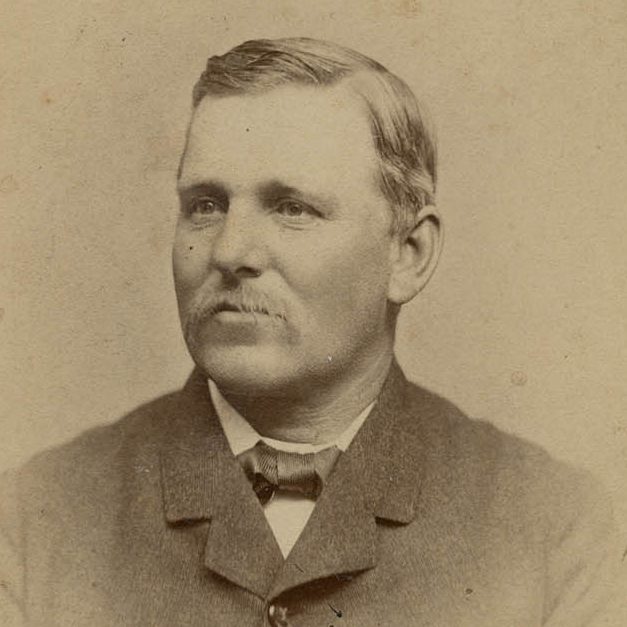
Photo credit: Massachusetts Historical Society
Soon after marrying and starting a family with the former Harriet “Hattie” Lathrop, the 24-year-old Munyan enlisted in the Union Army, and served in the 27th Massachusetts Infantry Regiment in the fight against the Confederacy.
Munyan served less than a year, as a musician in the regimental band, most likely playing a brass instrument such as a saxhorn or cornet. Bands such as these played a role in boosting regimental morale, and the 27th’s 24-man band was no exception. They developed their own musical repertoire, including an original composition called “Lee’s March,” not named for *that* Lee, but in honor of the 27th’s Colonel Horace C. Lee of Springfield, which elicited cheers upon their march out of Annapolis, according to W.P. Derby’s 1883 memoir of the 27th. Munyan’s service with the 27th was cut short at the end of August 1862 when a War Department edict downsized regimental bands. “The absence of the familiar strains of ‘Lee’s March,’ ‘Kate Kearney,’ and ‘Widow Machree,’ revealed how much their service had relieved the tedium of camp,” Derby later recalled.
Munyan returned to the Haydenville brass works until its destruction during the Mill River Disaster of 1874, when a dam failed and slammed the valley with floodwaters as high as 20 feet, killing 139 people and laying waste to sections of Williamsburg and Northampton. By then he was actively involved in local politics, serving as a selectman and town moderator in Williamsburg in the 1870s. Munyan transitioned into law enforcement and took on the position of a deputy sheriff for the district.
In 1879, Massachusetts Governor Thomas Talbot, a strict prohibitionist who supported women’s suffrage and prison reform, appointed Benson Munyan to the brand-new Massachusetts District Police, a precursor to the State Police that emerged from the battles over the creation of the country’s first state law enforcement agency. Created primarily to enforce prohibition laws, the Massachusetts State Constabulary was profoundly unpopular with voters and legislators (both teetotaling and not) uncomfortable with a centralized state force. As acting governor in 1874, Talbot had vetoed bills to disband the state police, a stance that lost him a re-election bid, only to see the legislature replace the booze-busting constables with a 15-man detective force charged with quelling riots and helping prosecutors find evidence.
When Talbot returned to office in 1879, he engineered a compromise, replacing the detective force with a deliberately modest District Police system designed to survive the public’s deep resistance to centralized policing. The District Police was actually slightly larger than the detective force it replaced, by one man. However, the new force featured a key difference in structure. Instead of a centralized detective unit, these 16 officers were distributed across the districts (two men to a district) and locally vetted, making them more politically palatable despite being marginally more sizable.
The District Police would last for 40 years, Talbot’s compromise laying the groundwork for greater acceptance of an expanded centralized force. In 1921 the Massachusetts legislature enlarged the agency to 50 officers stationed in barracks across the state, charged with enforcing the law in rural areas that didn’t have adequate police coverage.
Appointed by the governor and serving three-year terms, with annual salaries of $1,200, the state’s 16 detectives arrested over 460 suspects in their first year alone. They conducted criminal investigations, but were responsible for inspecting public buildings and elevators. Munyan would spend the next 20 years of his life (the last 20 years of his life) engaged in service to the State Detectives, covering the district that included Hampshire and Franklin Counties.
According to the annual reports of the Massachusetts District Police, Munyan was usually involved in well over 100 cases every year, clocking 838 investigations between 1891 and 1897 alone, and making 265 arrests during that period.
Described by one journalist as “lynx-eyed,” Munyan was seen by peers as a careful, meticulous investigator, conducting investigations with a relaxed, conversational demeanor, recovering stolen property and securing convictions through legwork, gathering statements, and developing informant networks in the hill towns of western Massachusetts. Colleagues remembered him as a familiar figure around the courthouse, such as “Lilly’s Court” in Greenfield, where he and other court regulars would swap stories and quietly compare notes.
Former Massachusetts Governor George Dexter Robinson, a practicing attorney in Springfield who would later gain notoriety for securing the acquittal of accused axe murderess Lizzie Borden, once described Munyan in a summation as having an “honest farmer’s face” that could make a suspect melt.
John A. Aiken, the DA for the Northwestern Judicial District, would later commend Munyan:
As a detective officer, he is acute, judicious, energetic and thorough. His cases are well prepared for trial. As a witness, he is direct and clear, and believed by juries. He is faithful, prompt, sagacious and honest by nature.
By the late 1880s, Munyan had built a name for himself investigating perplexing cases that ranged from the absurd to the tragic.
In 1885, he solved a decade-old cold case, the 1875 axe murder of Moses Dickinson, an opium-addicted farmer who lived alone near the Amherst border, robbed and killed by the vagrant Allen J. Adams, who’d been talking too much lately. Munyan tracked Adams to Tennessee, having confirmed the accidental confession with crime scene details, and sealed Adams’ date with a noose in Northampton, 1886. When asked for any final words at the gallows, Adams replied, “I have nothing to say, only to hope that somebody will stay to damn [Sheriff] Clark and Munyan.”
His investigations quelled rumor and panic, silencing stories that little Birdie Danahey had been abducted by vagrants in Amherst after she’d drowned in the Fort River in 1887, and clearing the widow Wissman of her husband’s shooting death in Shelburne the following year.
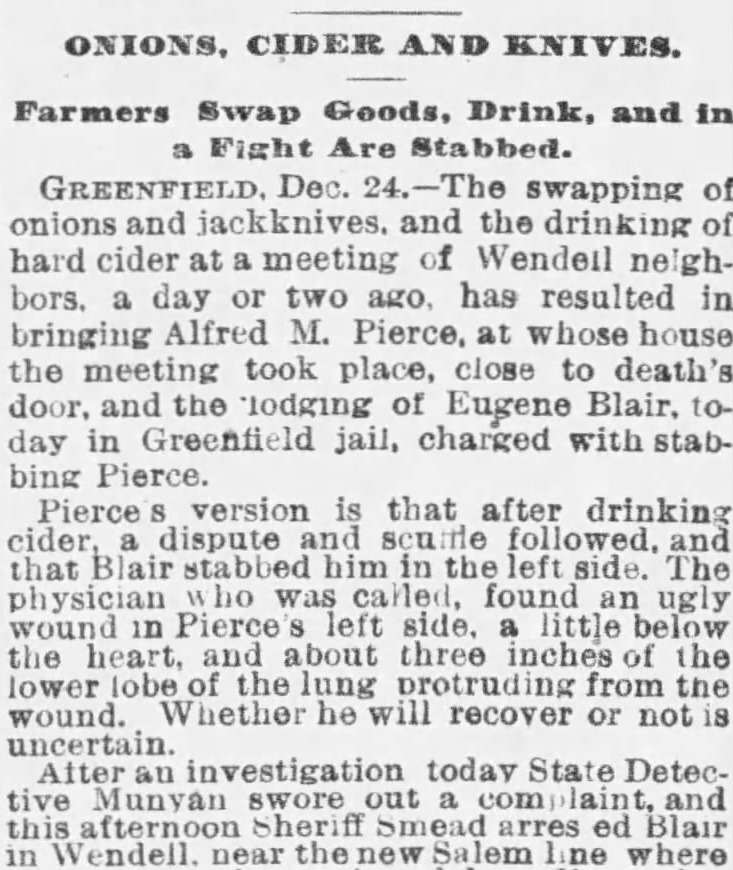
Not all his cases were successes. He’d found Paris green, an arsenic-based pigment once commonly used to dye book covers and kill rats, on the body of Irish immigrant Bridget “Biddy” Cahill, a character notorious around Easthampton, but the coroner could find none in her, and a jury acquitted those arrested for the crime, Mary Londergan of Easthampton and her daughter Mary Mahar. When Perley Hutchins was found with his throat cut and skull smashed in the burned remains of his Huntington mill in 1880, Munyan tracked suspects Hiram and Eugene Dailey—of the infamous Daileys of Peru, Mass.— to Ellington, Connecticut. His case fell apart when they produced an alibi from none other than the Shakers, with whom they’d been staying in nearby Enfield, Connecticut. The crime was later traced to Benjamin Eastman of Chester, Mass., who was judged not guilty on the grounds of insanity.
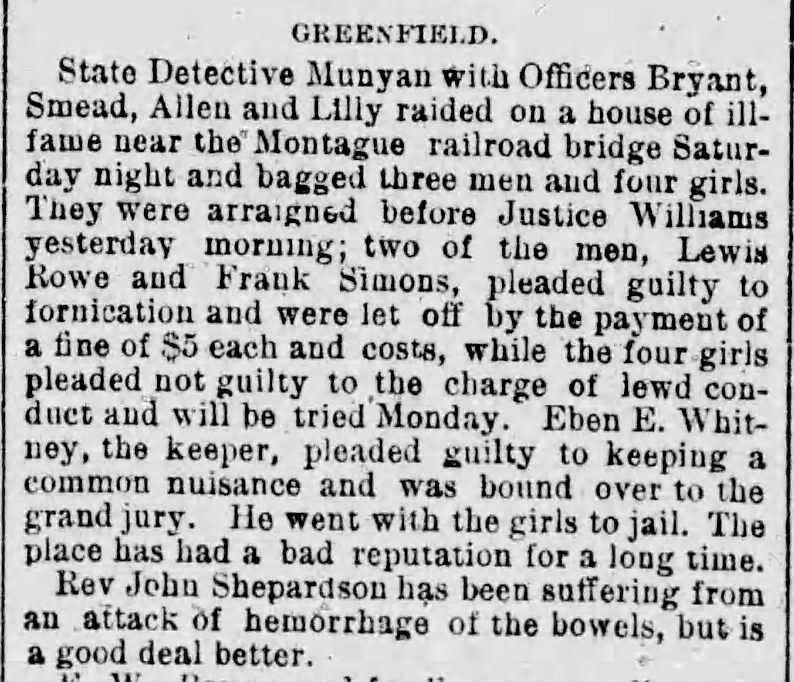
It was enough to disturb a pastor’s bowels.
Whether it was tracking down distillers of bootleg hootch up and down the valley, breaking up Ebenezer Whitney’s whorehouse in Greenfield, or retrieving stolen horses and chickens, the cases of Munyan’s career were followed diligently in the region’s dailies, with, “much in it of the thrill which comes from hunting down big game among criminals.”
Munyan’s collaring of Herbert M. Blanchard was hardly an example of master sleuthing, but it did provide a piece of evidence for which I owe the detective thanks utterly beyond measure.
TO BE CONTINUED: Benson Munyan’s Cabinet of Criminality


 The Many Wives of Herbert Blanchard
Leave a reply to Benson Munyan’s Cabinet of Criminality – The Many Wives of Herbert Blanchard Cancel reply